
Showing posts with label Teaching Techniques. Show all posts
Showing posts with label Teaching Techniques. Show all posts
Tuesday, July 01, 2014
Breaking the Ice in Teaching English
Breaking the ice in studying in the classroom is really important to keep the students fresh and paying attention. Here I provide an example of Ice breaker in teaching English. Enjoy it!


Language Assessment for ESL
Studying at English Department, one of many subjects we have is Language Assessment. It is a subject in which we study how to assess the students whether they have mastered the materials the teacher gave or not. Here are some Practical Ideas On Alternative Assessment For ESL Students on http://www.cal.org/resources/digest/tannen01.html
Resources
Online Resources: Digests
May 1996
Practical Ideas On Alternative Assessment For ESL Students
Jo-Ellen Tannenbaum, Montgomery County Public Schools (MD)
Many educators have come to recognize that alternative assessments are an important means of gaining a dynamic picture of students' academic and linguistic development. "Alternative assessment refers to procedures and techniques which can be used within the context of instruction and can be easily incorporated into the daily activities of the school or classroom" (Hamayan, 1995, p. 213). It is particularly useful with English as a second language students because it employs strategies that ask students to show what they can do. In contrast to traditional testing, "students are evaluated on what they integrate and produce rather than on what they are able to recall and reproduce" (Huerta- Macias, 1995, p. 9). Although there is no single definition of alternative assessment, the main goal is to "gather evidence about how students are approaching, processing, and completing real-life tasks in a particular domain" (Huerta-Macias, 1995, p. 9). Alternative assessments generally meet the following criteria:
- Focus is on documenting individual student growth over time, rather than comparing students with one another.
- Emphasis is on students' strengths (what they know), rather than weaknesses (what they don't know).
- Consideration is given to the learning styles, language proficiencies, cultural and educational backgrounds, and grade levels of students.
Saturday, June 28, 2014
Humor in The Classroom
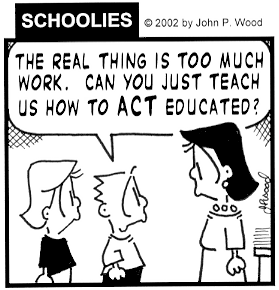
Humor in the classroom is important is important to keep the students fresh and paying attention to the teachers. Here is the video you can watch as reference how to make humor in the classroom. Humor in the Classroom

Subscribe to:
Posts (Atom)